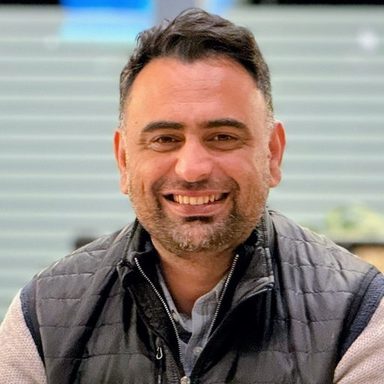
Noor Akbari
Hi, I'm Noor. I co-founded Rosalyn.ai in 2018 and have run product, sales, and fundraising there since. We've delivered over a million proctored exams at 20x lower cost and 500x the capacity we started with. This year I built two products by myself with AI coding agents: Caliber, an assessment platform, and Warmpath, a go-to-market engine.
I write about exam integrity, education, and Afghanistan, where I'm from.
Work I hope you'll read
-
The AI cheating crisis: education needs its anti-doping movement
Academic integrity needs the institutions, testing, and consequences that sport built for doping. Detection alone won't do it.
-
Exams will outlive everything else
If humans keep having value in the workforce, the exam is what tells us which humans. Why the exam survives when lectures, homework, and the degree all change shape, what an exam looks like a few years out, and three predictions for 2030 that could turn out wrong.
-
What guards the number
The year we tried to make proctoring cheap for Coursera, the cheating it let through, and what it taught me about north-star metrics: whatever number sits at the top needs a constraint and a falsifier that it can't average away.
-
Take the money, keep the plan
Coursera invested a million dollars in Rosalyn in 2020 and I spent a year building the product they wanted. Nobody asked me to; I pitched the pivot myself. The rule I took from it, and the half I was missing: an investment is not a purchase, and a pivot for one customer needs the purchase signed first.
-
I came to America as an interpreter. He came as a trained killer. We got the same resettlement plan.
On the failure of the Afghan resettlement process, written after the shooting of two National Guard members. I was an interpreter for the U.S. in Kabul; this one is personal.
-
Why some countries can't be built
The ghost soldiers I tried to fix in Kabul in 2007, cousin marriage in my own family, and why trust between strangers can't be widened faster than a society can carry. On Afghanistan, the Taliban, and what the West could still do.
About
If you're in Afghanistan and you want to go to university online, one of the problems is exams. The school has to trust someone taking an exam it can't see. That's the problem Rosalyn solves.
It's AI proctoring for high-stakes exams. A model watches the exam in real time and a human proctor makes every call. No student is accused by a model alone. Since 2018 we've run over a million exams in ten languages. Customers have included University of the People, which has 270,000 students, Coursera, Red Hat, and certification programs like Stripe's through partners. We also ran language testing for the U.S. Department of Defense through a contractor. Our fully loaded cost per exam went from $6 to under $0.30, and capacity from 20 concurrent exams to 10,000. I raised $7.2M, with Coursera among our investors. I ran product and sales and led 35 people across 7 countries, all remote. Martin, my co-founder, and I still work together and are still friends.
In 2026 I built two products alone, with AI coding agents. Warmpath is Rosalyn's go-to-market engine: a CRM, warm-introduction paths, and buyer intent in one app. I built it so we could sell without a sales team, and it has run our outbound since I finished it. Caliber is an assessment platform: describe an exam in plain language and it drafts the blueprint and items, delivers the exam, and scores it. Rosalyn uses it internally.
Before Rosalyn I founded INVEDYN, a remote language-testing company for U.S. government contractors. We shipped video-based remote proctoring in 2012 and delivered 200,000 tests in 80 languages.
Before that, in Kabul in my early twenties, I was an interpreter and advisor to the U.S. Department of Defense. I built and piloted the biometric ID system meant to stop "ghost soldier" payroll fraud in the Afghan National Army. It worked where the army could deploy it. I wrote about why in Why some countries can't be built.
I was born in Kabul in 1985 and grew up during three wars. My mother ran the family's first business: she bought surplus cooking oil from families who got more UN aid than they needed and sold it to families who got less. I learned English at seven because my sister laughed at how I pronounced the brand name on her sewing machine, then put the sewing down and taught me. As a teenager I opened Afghanistan's first digital printing shop and sold it. I live in San Diego with my wife and our five kids.
Media
-
How can proctoring create more opportunities for learners?
-
Top 50 Change Agents, 2024
-
Test me when I can: how an Afghan immigrant and a Swedish engineer are changing exam proctoring
On Martin and me.
-
My family is trapped in Afghanistan: an entrepreneur's story
Recorded during the fall of Kabul.
-
The cheating iceberg